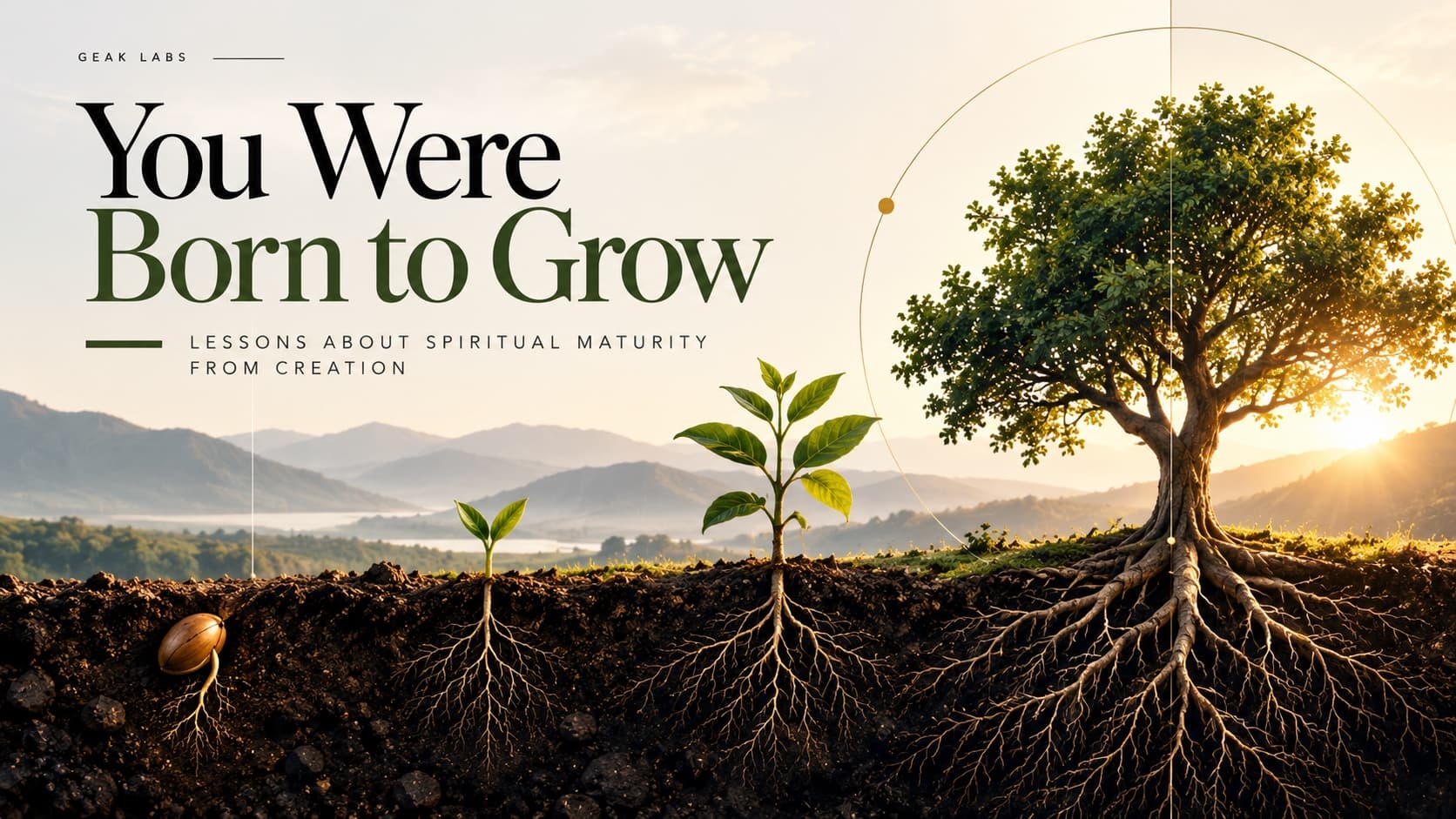
You Were Born to Grow
Lessons about spiritual maturity from creation. Seeds, roots, pruning and seasons: living things are expected to grow, and the Christian life is a life we were born into, not a moment we once believed.
“The heavens declare the glory of God; and the firmament shows His handiwork.”
— Psalm 19:1
Creation teaches.
Not independently of Scripture.
Not as a replacement for revelation.
But because the world bears the fingerprints of its Creator.
Jesus repeatedly pointed people toward ordinary things and said, in effect:
Look again.
Consider the lilies.
Watch the birds.
Observe seed falling into soil.
Look at a vine.
Look at a fig tree.
Watch a farmer.
Consider a mustard seed.
God has filled creation with processes that make invisible realities easier to understand.
Paul says God's invisible attributes are perceived through what He has made.
Proverbs tells the lazy person to study the ant.
Job points toward animals, birds, earth and sea as teachers.
So perhaps we lose something when we rush through creation without allowing it to speak.
One pattern in creation is particularly difficult to miss:
Living things are expected to grow.
A seed that remains permanently a seed has never entered the fullness of what was inside it.
A child who remains physically and mentally at infancy has encountered a problem.
A tree that never develops roots cannot withstand difficult weather.
And Scripture applies precisely this kind of language to the Christian life.
We are born.
Then we are expected to grow.
New Birth Really Means a Beginning
Jesus tells Nicodemus:
“Unless one is born again, he cannot see the kingdom of God.”
— John 3:3
The metaphor is extraordinary.
He does not simply describe salvation as changing opinions.
He describes it as birth.
Birth is miraculous.
But birth is not maturity.
When a baby is born, everyone celebrates.
Nobody complains:
“Why can't she walk yet?”
She has only just arrived.
Dependence is appropriate.
Milk is appropriate.
Limited understanding is appropriate.
But imagine the same conversation twenty years later.
At some point, what was completely normal in infancy becomes evidence that development has stopped.
Paul uses exactly this imagery when addressing the Corinthians:
“I fed you with milk and not with solid food; for until now you were not able to receive it…”
— 1 Corinthians 3:2
The writer of Hebrews says something similar:
“Everyone who partakes only of milk is unskilled in the word of righteousness, for he is a babe.”
Then:
“Solid food belongs to those who are of full age…”
The problem isn't milk.
Babies need milk.
The problem is never progressing beyond it.
Salvation Is Not Earned by Maturity
There is an important theological distinction here.
Spiritual growth does not purchase salvation.
We do not begin with Christ and then remain accepted by God because our performance becomes impressive enough.
Paul writes:
“By grace you have been saved through faith… it is the gift of God, not of works.”
— Ephesians 2:8–9
But he immediately continues:
“For we are His workmanship, created in Christ Jesus for good works…”
That order matters.
We are not saved by good works.
We are saved for a transformed life.
Fruit does not make a tree alive.
A living tree produces fruit because it is alive.
So when Jesus talks about recognising trees by their fruit, He is not teaching us how to purchase God's acceptance.
He is showing us that genuine life eventually becomes visible.
Grace receives us where we are.
But grace does not intend to leave us unchanged.
Growth Happens Gradually
Creation teaches another important lesson:
Most genuine growth is slow.
Plant a seed today.
You can stare at the soil for six hours and see nothing.
Return tomorrow.
Perhaps still nothing.
That does not mean nothing is happening.
Roots often develop where nobody can see them before visible growth emerges above the ground.
This challenges our obsession with immediate spiritual results.
We pray intensely for three days and wonder:
“Why haven't I changed?”
We study Scripture for a week and become frustrated that discernment still feels difficult.
We fight an old habit and conclude that because the battle continues, growth has failed.
But God frequently works through processes.
Paul tells the Corinthians:
“I planted, Apollos watered, but God gave the increase.”
— 1 Corinthians 3:6
Planting.
Watering.
Increase.
Process.
Spiritual growth may therefore be occurring even during seasons in which visible results are frustratingly small.
Roots Come Before Height
A tree teaches another lesson.
We notice height.
God often seems interested in roots.
A tree without sufficient roots may look impressive in calm weather.
The problem becomes visible only when wind arrives.
Jesus tells a parable about two houses.
Both houses apparently stood successfully for some time.
Then rain came.
Floods came.
Wind came.
The difference was foundation.
Storms reveal structures that ordinary weather conceals.
Something similar happens spiritually.
It is possible to appear mature when life is cooperating with us.
Then:
money becomes uncertain,
a relationship breaks,
a prayer seems unanswered,
someone mistreats us,
our plans collapse,
God appears silent.
Suddenly we discover whether our confidence had roots.
Trials do not always create what is inside us.
Often they reveal it.
James therefore writes:
“The testing of your faith produces patience.”
Roots often grow in dark places.
Pruning Is Also Growth
Jesus takes the imagery further in John 15:
“Every branch that bears fruit He prunes, that it may bear more fruit.”
That sounds almost contradictory.
The branch is fruitful.
Yet something is removed.
Why?
So it can become more fruitful.
One of the difficult lessons of Christian maturity is that loss does not automatically mean God has abandoned us.
Sometimes reduction is preparation.
God may challenge:
habits,
relationships,
ambitions,
assumptions,
patterns of thinking,
even activities that are not inherently sinful.
Not every removal is punishment.
Sometimes God removes what was appropriate for one season because it would restrict the next.
The branch may experience the knife as loss.
The gardener understands it as cultivation.
Fruit Cannot Be Manufactured
A tree does not wake up and scream:
“Today I must produce an apple!”
Fruit emerges because the tree remains healthy and connected to its source.
Jesus says:
“Abide in Me, and I in you… he who abides in Me, and I in him, bears much fruit.”
That word abide changes how we think about spiritual development.
Christianity is not fundamentally behaviour modification.
It is life flowing from union with Christ.
We pray.
We study.
We obey.
We practise disciplines.
But those things are not an attempt to manufacture artificial fruit.
They are ways of remaining oriented toward the One from whom life comes.
Galatians therefore calls love, joy, peace, patience, kindness, goodness, faithfulness, gentleness and self-control:
the fruit of the Spirit.
Not merely the fruit of superior human discipline.
Infants Learn Language by Relationship
A new believer's development can be compared to the way a child learns to communicate.
The image needs careful framing, but it is useful.
A baby is born into voices.
Long before the child can analyse grammar, she hears language.
At first, sounds are simply sounds.
Gradually patterns become familiar.
A particular voice becomes recognisable.
Meaning develops.
Eventually the child speaks.
Something similar happens as we mature in knowing God.
At first, Scripture may feel difficult.
We may confuse our emotions, desires, fear and cultural assumptions with God's leading.
But over time we become increasingly formed by His revealed Word.
His character becomes more familiar.
His ways become less foreign.
Not because every internal thought becomes God's voice.
Rather, our minds are increasingly trained to recognise what is consistent with the God Scripture reveals.
Hebrews describes mature believers as those who, through practice, have their senses exercised to discern good and evil.
Notice again:
through practice.
Discernment develops.
Children Must Eventually Learn to Walk
There is another stage every parent recognises.
Eventually a child tries to stand.
Then falls.
Stands again.
Falls again.
Takes two steps.
Falls.
Nobody interprets falling as evidence that the child was never meant to walk.
The falling is occurring because walking is being learned.
That has helped me think differently about spiritual failure.
A mature response to failure is neither:
“It doesn't matter.”
nor:
“I fell, therefore I am hopeless.”
It is:
“What must I learn so that I walk differently?”
Peter failed dramatically.
The same Peter eventually became a leader in the early church.
Failure did not become permission.
But neither did failure become his permanent identity.
Growth involves correction.
Every Stage Has Different Responsibilities
We do not expect the same thing from an infant, a child and an adult.
Scripture contains a similar expectation of development.
At some point we move from constantly needing someone else to feed us toward being able to study Scripture ourselves.
From only receiving encouragement toward encouraging others.
From constantly being discipled toward discipling.
From asking only:
“What can I receive?”
toward:
“How can my life serve?”
This does not mean mature Christians stop needing teachers.
Adults still eat.
Adults still learn.
Adults still need community.
Maturity does not produce independence from the body of Christ.
It produces the ability to contribute to it.
Seasons Are Not the Same as Stagnation
Creation also teaches us about seasons.
A tree in winter can appear dead.
There is no fruit.
Little visible growth.
Perhaps no leaves.
But winter and death are not identical.
There are spiritual seasons in which God seems extraordinarily active.
Insight comes easily.
Prayer feels alive.
Opportunities open.
Other seasons feel quiet.
The mistake is assuming:
“I cannot see fruit, therefore nothing is happening.”
Some seasons are for fruit.
Others are for roots.
Others are for pruning.
Others are for rest.
Maturity includes learning not to demand summer from every season.
Growth Requires Environment
Take a healthy seed.
Place it on concrete.
Its potential remains real.
Its environment is hostile.
Soil matters.
Water matters.
Light matters.
Likewise, environment matters spiritually.
The people around us matter.
What we repeatedly consume matters.
Church community matters.
Teaching matters.
Our habits matter.
Accountability matters.
This is why Scripture tells us not to abandon gathering together.
Christianity was never designed as an isolated experiment.
A plant separated from the ecosystem required for life struggles unnecessarily.
So does a believer.
Growth Is Toward Someone
The objective of spiritual maturity is not simply becoming more religious.
Paul describes the destination as:
“the measure of the stature of the fullness of Christ.”
— Ephesians 4:13
Christ is the pattern.
The goal is not:
“I know more theological terminology than I did five years ago.”
Knowledge matters.
But knowledge without transformation can become pride.
The deeper question is:
Am I becoming more like Christ?
More loving?
More truthful?
More courageous?
More patient?
More holy?
More generous?
More forgiving?
More submitted to God?
More able to control my desires?
More concerned with serving than being seen?
That is fruit.
Creation Refuses to Hurry, Yet It Refuses to Remain the Same
Perhaps this is what fascinates me most.
Creation contains both patience and inevitability.
You cannot shout at a seed into becoming a tree tomorrow.
But if years pass and nothing grows, something is wrong.
That tension is useful in the Christian life.
We need patience with ourselves and others.
Transformation takes time.
But patience must not become an excuse for permanent stagnation.
The question is not:
“Have I arrived?”
None of us has.
The better question is:
“Am I growing?”
Can I identify areas where God has changed me?
Are there things that once controlled me that no longer do?
Is my understanding deepening?
Is my love increasing?
Am I quicker to repent?
Am I becoming less defensive?
Can God entrust more to me?
Am I increasingly able to recognise His character and ways through Scripture?
The Gardener Is Still at Work
The encouraging thing about all these images is that growth does not depend entirely on the plant.
There is a Gardener.
Jesus says:
“My Father is the vinedresser.”
Paul says:
“God gave the increase.”
This protects us from both laziness and despair.
I participate.
I remain.
I obey.
I study.
I practise.
I repent.
I allow myself to be corrected.
But ultimately, spiritual life originated from God and depends on God.
Perhaps maturity therefore means becoming increasingly cooperative with what God is growing.
The infant becomes a child.
The child learns to walk.
The roots deepen.
The branches stretch.
The seasons change.
The Gardener prunes.
Fruit appears.
Then more fruit.
The process continues.
The Christian life is not merely a moment in which we once believed.
It is a life into which we have been born.
And living things were made to grow.


When God Does Not Answer the Way We Expected
Faith is not proved by always receiving the outcome we asked for. Sometimes faith is continuing to trust God when His answer differs from our expectation.
October 7, 2026 · 3 min read
Ask, Seek, Knock
Persistence is not trying to exhaust a reluctant God. It is continuing to trust a willing Father.
October 7, 2026 · 3 min read
Pray and Watch
Faith does not force a choice between prayer and responsibility. Nehemiah prayed—and set a watch.
October 7, 2026 · 3 min read