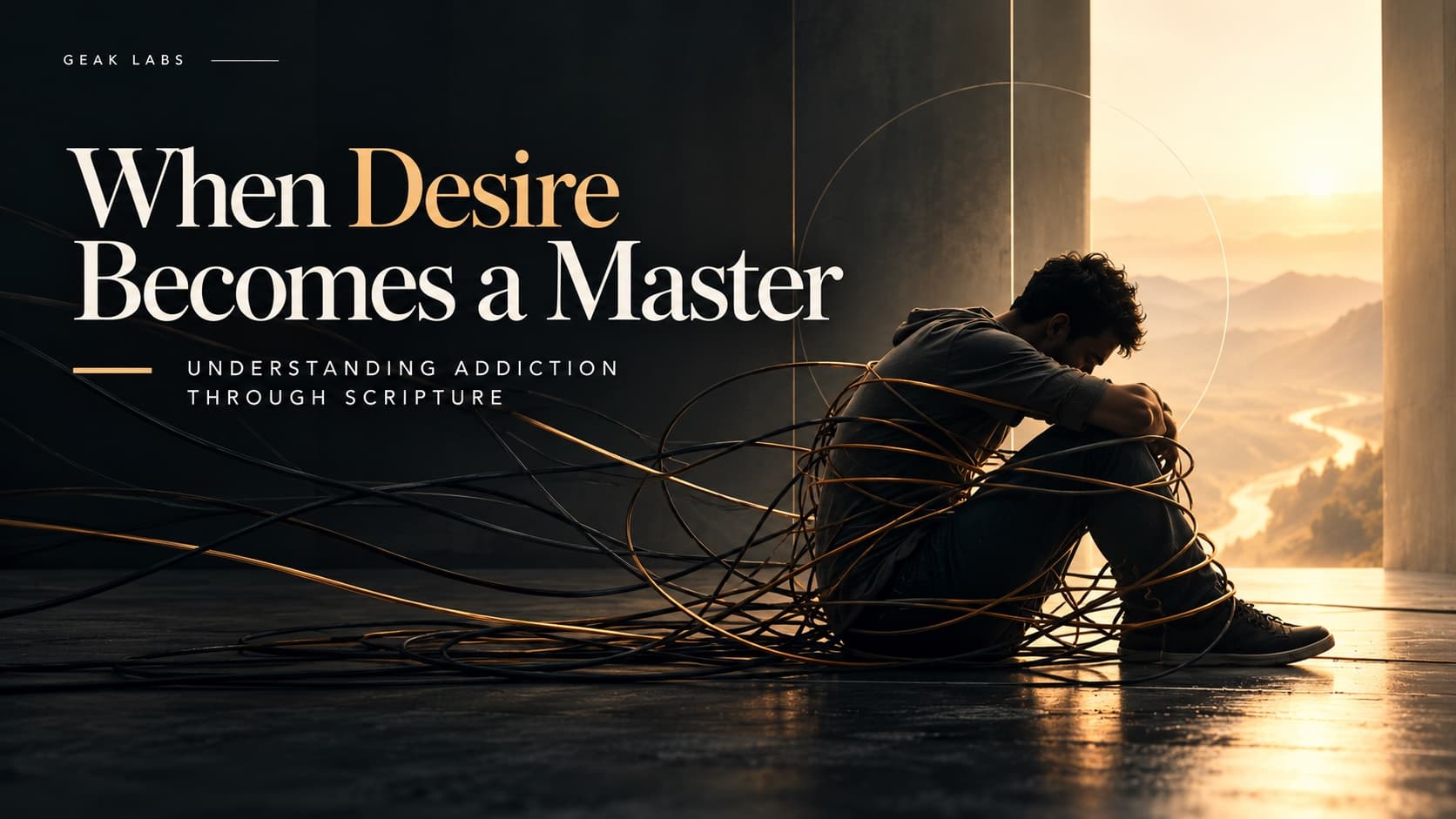
When Desire Becomes a Master
Understanding addiction through Scripture. Something doesn't have to be evil to master us — the question is what has acquired power over me, and how the gospel addresses captivity, not just guilt.
“All things are lawful for me, but I will not be brought under the power of any.”
— 1 Corinthians 6:12
There is a difference between enjoying something and being mastered by it.
That distinction has increasingly shaped the way I think about addiction.
When we hear the word addiction, our minds often move immediately toward alcohol, drugs, gambling, pornography or some other behaviour that has obviously become destructive.
Those are real and serious forms of addiction.
But Scripture introduces an even broader question:
What has acquired power over me?
What can I no longer comfortably say no to?
What do I repeatedly return to despite knowing that it is harming me?
What has begun determining my decisions, emotions, time, money, relationships or relationship with God?
Paul makes a remarkable statement:
“I will not be brought under the power of any.”
That gives us a useful biblical lens.
Something does not have to be inherently evil before it becomes capable of mastering us.
Food is good.
Money can be used for good.
Work is good.
Rest is good.
Technology can be good.
Entertainment can be good.
Recognition can feel good.
Even ministry can be good.
But good things can occupy disordered places in the human heart.
And when something begins moving from something I use to something that controls me, a spiritual problem has emerged.
Addiction Is More Than a Bad Habit
There is also an important distinction to make here.
Clinical addiction is not simply another word for “sinful behaviour.”
Substance dependence and other addictions can involve powerful psychological and physiological processes. A person may experience cravings, tolerance, withdrawal and significant difficulty stopping even while genuinely wanting to stop. Some forms of withdrawal, particularly severe alcohol dependence, can require medical treatment and can be dangerous if handled incorrectly.
So Christians should be careful not to reduce addiction to:
“You simply need more willpower.”
Prayer, repentance and spiritual formation matter deeply.
But seeking medical treatment, counselling, rehabilitation or structured recovery support is not evidence of weak faith.
God can work through doctors.
He can work through therapists.
He can work through accountability.
He can work through treatment programmes.
Grace and practical help are not competitors.
Yet Scripture still has something profound to say about addiction because beneath many forms of destructive behaviour lies a larger biblical theme:
bondage.
“What I Want to Do, I Do Not Do”
Romans 7 contains one of Scripture's most painfully recognisable descriptions of internal conflict.
Paul describes knowing what is right while finding himself doing what he hates.
There is something disturbingly familiar in that experience.
A person says:
“This is the last time.”
And returns.
“Tomorrow I will stop.”
And returns.
“I hate what this is doing to me.”
And returns.
Desire and behaviour seem to have separated from intention.
The person is no longer merely choosing something.
Increasingly, the thing appears to be choosing for them.
Peter uses similarly strong language:
“For by whom a person is overcome, by him also he is brought into bondage.”
— 2 Peter 2:19
That word matters:
bondage.
Scripture consistently portrays sin not merely as breaking rules but as a power that seeks mastery.
Jesus says:
“Whoever commits sin is a slave of sin.”
— John 8:34
The gospel therefore addresses more than guilt.
It addresses captivity.
The First Temptation Was About Desire
Genesis 3 gives us an extraordinary anatomy of temptation.
The serpent speaks.
Eve listens.
Then Scripture says:
“When the woman saw that the tree was good for food, that it was pleasant to the eyes, and a tree desirable to make one wise…”
Something is happening internally before anything happens externally.
The fruit becomes:
good
then pleasant
then desirable.
And finally:
taken.
James later describes a similar process:
“Each one is tempted when he is drawn away by his own desires and enticed. Then, when desire has conceived, it gives birth to sin…”
— James 1:14–15
That progression deserves attention.
Temptation does not normally begin with behaviour.
It frequently begins much earlier.
Attention.
Imagination.
Desire.
Rationalisation.
Permission.
Then action.
And repeated action can eventually become habit.
Habit can become dependence.
Dependence can become bondage.
This is why winning the battle only at the point of behaviour is extraordinarily difficult.
By then, many other battles have already been lost.
What We Repeatedly Feed Becomes Stronger
The human mind is extraordinarily formative.
What I repeatedly expose myself to changes what feels normal.
What I repeatedly imagine changes what I desire.
What I repeatedly practise becomes easier to repeat.
Scripture understood this long before we had modern language for habit formation.
Paul writes:
“Whatever things are true, whatever things are noble, whatever things are just, whatever things are pure… meditate on these things.”
— Philippians 4:8
Proverbs says:
“Keep your heart with all diligence, for out of it spring the issues of life.”
— Proverbs 4:23
This doesn't mean that every addiction disappears merely by thinking positive thoughts.
It means our attention matters.
Our environment matters.
Our inputs matter.
Our relationships matter.
Our routines matter.
You cannot continually feed one appetite while praying for another appetite to dominate it.
Sometimes spiritual warfare looks remarkably practical.
Deleting the app.
Changing the route home.
Ending access.
Avoiding the environment.
Calling someone before the craving grows.
Installing accountability.
Changing friendships.
Going to therapy.
Getting medical support.
Confessing instead of hiding.
The Bible's call to “flee” certain things is striking precisely because sometimes the spiritual response is not to prove how strong you are by remaining close to temptation.
Sometimes victory looks like leaving.
Satan Tempts, but Temptation Is Not the Same as Sin
It is easy to place most of the emphasis on Satan's role in temptation.
His role does matter.
Scripture describes him as deceiver, tempter and accuser.
But Scripture never allows us to use Satan as an explanation that removes human responsibility.
The serpent deceived Eve.
Eve still ate.
Adam still ate.
James is particularly direct:
“Each one is tempted when he is drawn away by his own desires and enticed.”
That produces an important balance.
We should neither pretend spiritual opposition does not exist nor attribute every destructive decision to Satan.
The enemy may lie.
But lies gain influence when they are believed.
He may tempt.
But temptation and consent are not identical.
This distinction is hopeful because it means temptation itself is not defeat.
A thought can arrive without becoming your identity.
A desire can be felt without becoming your master.
A temptation can be resisted without becoming behaviour.
Sometimes Addiction Is an Attempt to Treat Another Pain
There is another layer that deserves compassion.
People do not always become dependent on something simply because they love pleasure.
Sometimes the behaviour became a way of surviving something else.
Loneliness.
Trauma.
Anxiety.
Shame.
Grief.
Rejection.
Stress.
Emptiness.
A substance or behaviour may initially provide temporary relief.
Then relief becomes repetition.
Repetition becomes dependence.
Eventually the attempted solution creates an additional problem.
This is one reason shame alone rarely heals addiction.
If a person is already using something to escape pain, adding condemnation without helping them confront the underlying pain can drive them deeper into hiding.
Jesus repeatedly did something different.
He brought truth and grace together.
He did not redefine sin as harmless.
But neither did He approach broken people as though disgust would transform them.
The Gospel Offers More Than Behaviour Management
Christianity's answer to bondage is not simply:
Try harder.
It begins with something far more radical:
You need a new source of life.
Jesus says:
“If the Son makes you free, you shall be free indeed.”
— John 8:36
The gospel announces that Christ deals with both the guilt and dominion of sin.
But that freedom should not be confused with the idea that every struggle instantly disappears at conversion.
The New Testament speaks repeatedly to believers about putting things to death, renewing the mind, walking by the Spirit, resisting temptation and growing in self-control.
Why?
Because freedom is both something Christ gives and something we learn to walk in.
Paul writes:
“Walk in the Spirit, and you shall not fulfil the lust of the flesh.”
— Galatians 5:16
Notice again the language of movement.
Walk.
Christian freedom is not merely something that happened to me.
It increasingly becomes a way I live.
Grace Does Not Mean Passivity
There can be two opposite mistakes.
One says:
“I will defeat this entirely through discipline.”
The other says:
“If God wants me free, He will simply remove the desire.”
Scripture gives us something richer.
God works in us.
And because God works in us, we act.
Paul says:
“Work out your own salvation with fear and trembling; for it is God who works in you both to will and to do for His good pleasure.”
— Philippians 2:12–13
God's activity does not eliminate ours.
It makes ours possible.
So recovery may involve prayer and accountability.
Scripture and therapy.
Fasting and removing access.
Faith and rehabilitation.
Confession and practical boundaries.
The Holy Spirit is not threatened by practical wisdom.
The Fruit of the Spirit Includes Self-Control
Galatians 5 gives us an important picture of transformation.
The Spirit produces:
love,
joy,
peace,
patience,
kindness,
goodness,
faithfulness,
gentleness,
and self-control.
Self-control is interesting because it means Christian maturity increasingly restores appropriate government over desire.
Desire stops being king.
Christ becomes Lord.
The person can gradually say:
“I want this, but wanting it does not mean I must obey it.”
That is freedom.
Not necessarily the absence of temptation.
But the end of temptation's unquestioned authority.
Secrecy Strengthens What Light Weakens
Addiction often survives through secrecy.
Shame says:
“Hide this until you have fixed yourself.”
The gospel says:
“Bring darkness into the light.”
James tells believers:
“Confess your trespasses to one another, and pray for one another, that you may be healed.”
Confession is frightening because addiction frequently convinces us that being known will lead to rejection.
But secrecy creates a private ecosystem in which destructive behaviours can grow without challenge.
Freedom often begins when someone else finally knows the truth.
Not everyone needs to know.
But someone trustworthy often should.
Relapse Does Not Have to Become Identity
Another danger is defining a person entirely by their struggle.
“I am an addict.”
“I will always be this way.”
“I failed again, so nothing changed.”
Christianity does not teach denial.
But neither does it teach that our worst pattern has the right to become our deepest identity.
Paul tells believers:
“Such were some of you. But you were washed, but you were sanctified, but you were justified…”
— 1 Corinthians 6:11
The Christian story contains the possibility of genuine transformation.
That transformation may be dramatic.
Sometimes it is painfully gradual.
Sometimes a person falls and gets up repeatedly while learning new patterns.
The presence of a battle does not necessarily mean God is absent from the battlefield.
What Has Mastery Over Me?
Perhaps addiction forces all of us to confront a question broader than substances.
Paul's statement remains challenging:
“I will not be brought under the power of any.”
So I have started asking:
What happens when I cannot access my phone?
How dependent am I on people's approval?
Can I rest without feeling guilty?
Can I give without money controlling my sense of security?
Can I stop working?
Can I walk away from entertainment?
Can I control what I eat?
What happens internally when something I enjoy becomes unavailable?
Not everything we struggle to release is clinically an addiction.
We should not trivialise that word.
But those questions can reveal attachments.
And attachments deserve examination before they become masters.
Freedom Has a Person at Its Centre
Ultimately, Christianity does not merely offer better habits.
It offers Christ.
The goal is not simply becoming a highly disciplined version of ourselves.
It is becoming increasingly free to love God and others without being governed by competing masters.
This is why Jesus' language is so significant:
“If the Son makes you free, you shall be free indeed.”
Freedom is not merely the ability to do whatever I want.
Sometimes that is precisely how bondage begins.
Freedom is increasingly possessing the ability to refuse what destroys me and choose what gives life.
To say:
No, even though I desire it.
And:
Yes, even when obedience is difficult.
There may be medical dimensions to recovery.
Psychological dimensions.
Relational dimensions.
Environmental dimensions.
Spiritual dimensions.
We should not unnecessarily force them into competition.
God is interested in the whole person.
And perhaps the deepest question is not simply:
“How do I stop this behaviour?”
But:
“Who or what is becoming my master?”
Because the Christian confession is ultimately this:
Jesus Christ is Lord.
And anything else demanding the place of Lord deserves to be confronted—not with shame alone, but with truth, grace, wisdom, community, appropriate help, and the liberating power of God.
When God Does Not Answer the Way We Expected
Faith is not proved by always receiving the outcome we asked for. Sometimes faith is continuing to trust God when His answer differs from our expectation.
October 7, 2026 · 3 min read
Ask, Seek, Knock
Persistence is not trying to exhaust a reluctant God. It is continuing to trust a willing Father.
October 7, 2026 · 3 min read
Pray and Watch
Faith does not force a choice between prayer and responsibility. Nehemiah prayed—and set a watch.
October 7, 2026 · 3 min read