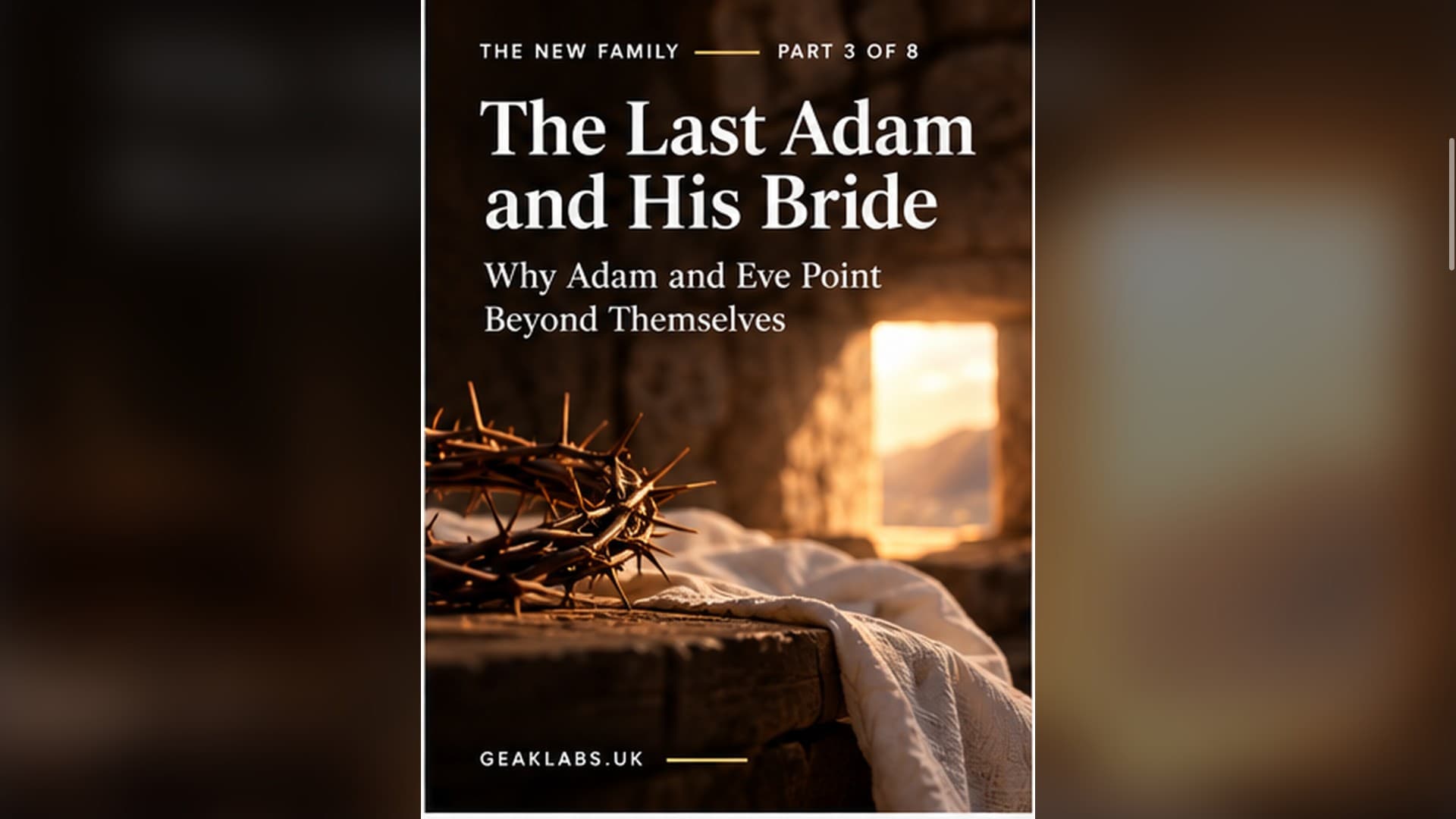
The Last Adam and His Bride
The New FamilyPart 3 of 8
The first Adam received a bride after deep sleep. The Last Adam gave Himself in death and rose to receive a redeemed Bride.
Why Adam and Eve Point Beyond Themselves
Some biblical patterns become visible only when later Scripture teaches us how to look backward.
Adam and Eve are one example.
Their story is certainly about the first man and woman.
It is about marriage.
Human companionship.
Family.
Creation.
But the New Testament also tells us that their story points beyond itself.
Paul quotes Genesis 2:
“The two shall become one flesh.”
Then he says:
“This is a great mystery, but I speak concerning Christ and the church.”
Suddenly the first marriage becomes part of a much larger story.
Adam Was a Type of Someone to Come
Romans describes Adam as:
“a type of Him who was to come.”
That does not mean every detail of Adam's life is a prediction of Jesus.
Typology requires care.
But Scripture itself establishes the Adam–Christ relationship.
The first Adam stands at the beginning of one humanity.
Christ, the Last Adam, stands at the beginning of another.
And once Paul connects Adam with Christ, he also explicitly connects marriage in Genesis with Christ and His Church.
That allows us to look again at Genesis 2.
The First Adam and His Bride
Genesis says:
“It is not good that man should be alone.”
God causes Adam to fall into a deep sleep.
His side is opened.
From him, God forms the woman.
Adam awakens and receives her with joy:
“This is now bone of my bones and flesh of my flesh.”
Then Scripture gives us the pattern:
“A man shall leave his father and mother and be joined to his wife, and they shall become one flesh.”
This is the beginning of human marriage.
But Paul says there is also mystery here.
The Last Adam and His Bride
When we come to the New Testament, Christ is presented as Bridegroom.
The Church is presented as His Bride.
Ephesians says:
“Christ also loved the church and gave Himself for her.”
The language is covenantal.
Sacrificial.
Relational.
Christ does not merely save disconnected individuals.
He gives Himself for a people.
Sleep and Death
This is where the typological parallel becomes striking.
Adam enters deep sleep.
Christ enters death.
Adam's side is opened.
Christ's side is pierced.
Adam awakens and receives a bride.
Christ rises from the dead, and through His saving work a redeemed Bride is gathered.
We should be careful here.
The New Testament does not explicitly say Adam's sleep predicts the exact three days of Christ's burial.
Jesus explicitly associates that three-day sign with Jonah.
So this should be treated as typological correspondence, not as a hidden prediction Scripture itself never makes.
But the broader pattern is meaningful.
The first Adam enters sleep before receiving his bride.
The Last Adam gives Himself in death and rises to receive His Bride.
The Church Receives Life From Christ
Eve is distinct from Adam.
Yet her formation is connected to Adam.
The Church is also distinct from Christ.
The Church is not Christ.
And the Church certainly does not become divine.
Yet the Church receives its new-creation life from Him.
Paul calls Christ:
“the Head of the body, the church.”
And he describes the Body as growing from the Head.
Christ is therefore not merely the One giving orders from above.
He is the source of the Body's life.
One Flesh and One Body
Marriage produces union without erasing distinction.
The husband does not become the wife.
The wife does not become the husband.
Yet Scripture describes them as one flesh.
Paul then uses similar organic language for Christ and the Church.
Many members.
One Body.
One Head.
The relationship is intimate without collapsing the difference between Christ and His people.
The Bride Is Being Prepared
Ephesians also describes Christ as sanctifying His Bride.
He intends to present her:
“glorious… holy and without blemish.”
That means the Bride is both already His and still being prepared.
This explains something important about the present Church.
The Church belongs to Christ.
But the Church is not yet everything she will be.
She is being sanctified.
Formed.
Corrected.
Cleansed.
Matured.
The final beauty of the Bride will be the result of the Bridegroom's work.
The Bible Begins With Marriage
There is something beautiful about the shape of Scripture.
Genesis begins humanity's story with a marriage in a garden.
A man.
A woman.
God's presence.
Fruitfulness.
Creation.
Then Revelation brings us to:
“the marriage of the Lamb.”
The Bride has made herself ready.
The new creation arrives.
God dwells with humanity.
The tree of life appears again.
The Bible moves from the first Adam and his bride toward the Last Adam and His redeemed Bride.
Marriage Was Always Bigger Than Marriage
This does not make ordinary marriage unimportant.
Quite the opposite.
Paul's argument in Ephesians is that Christian marriage should reflect something of Christ's covenant love.
The husband is told to love sacrificially.
The marriage relationship becomes a living signpost.
Not because marriage saves us.
But because earthly marriage can point toward a greater union.
The Bridegroom Gave Himself
At the centre of the Christian story is not the Bride's beauty.
It is the Bridegroom's love.
“Christ loved the church and gave Himself for her.”
The Church's story begins with His action.
His sacrifice.
His death.
His resurrection.
His grace.
The Bride is not loved because she first made herself perfect.
She is made beautiful because she is loved.
That is perhaps the deepest part of the mystery.
The first Adam slept and received a bride.
The Last Adam died and rose to receive a Bride.
And Scripture ends with that Bride prepared, redeemed and finally joined to her Bridegroom in the new creation.
When God Does Not Answer the Way We Expected
Faith is not proved by always receiving the outcome we asked for. Sometimes faith is continuing to trust God when His answer differs from our expectation.
October 7, 2026 · 3 min read
Ask, Seek, Knock
Persistence is not trying to exhaust a reluctant God. It is continuing to trust a willing Father.
October 7, 2026 · 3 min read
Pray and Watch
Faith does not force a choice between prayer and responsibility. Nehemiah prayed—and set a watch.
October 7, 2026 · 3 min read