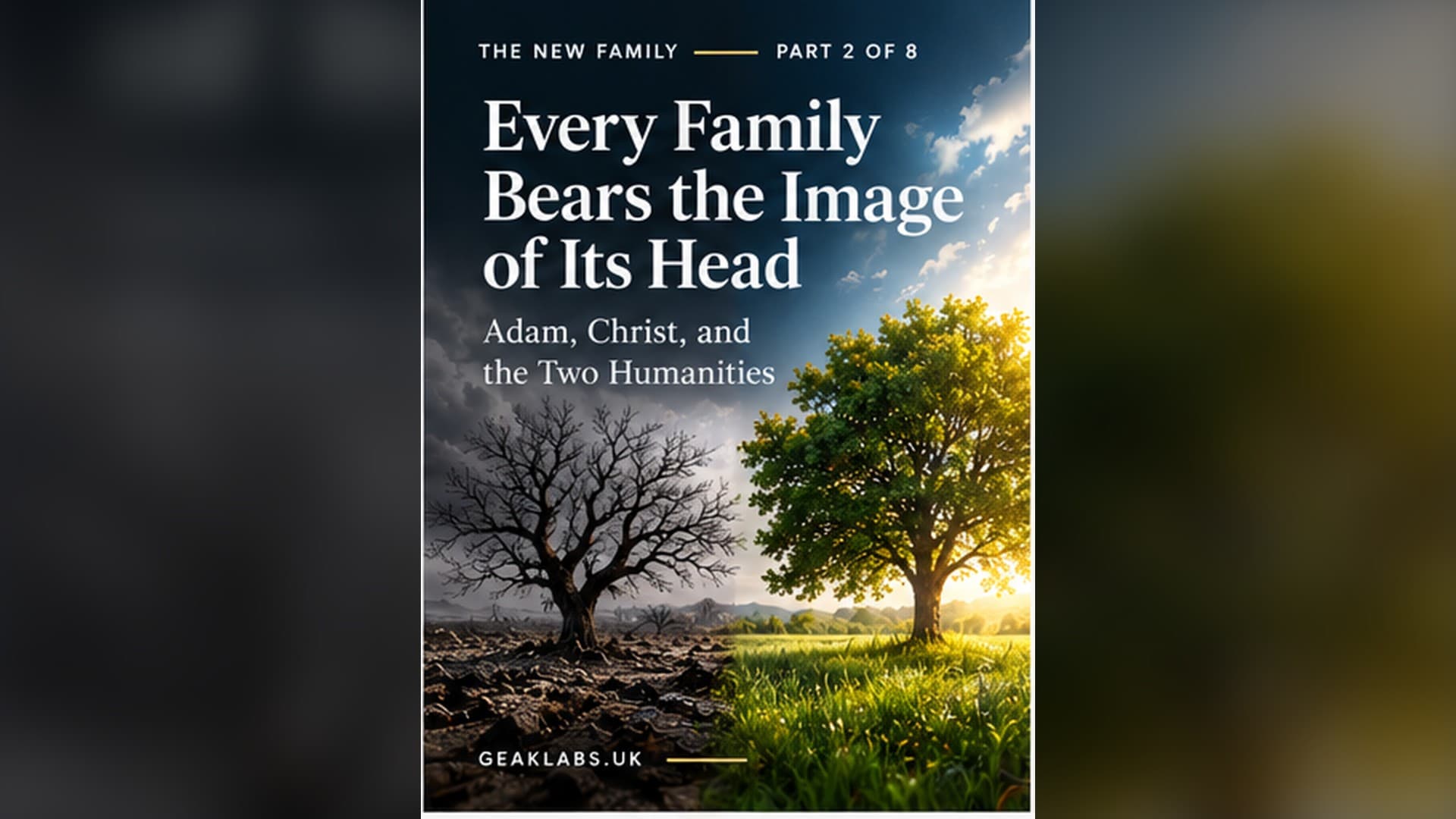
Every Family Bears the Image of Its Head
The New FamilyPart 2 of 8
Every humanity carries the likeness of its source. In Adam we bear the earthly image; in Christ we are being formed into the image of the heavenly Man.
Adam, Christ, and the Two Humanities
Families often reveal resemblance.
A child smiles in a way that reminds you of her mother.
Another walks like his father.
Sometimes the resemblance is physical.
Sometimes it is temperament.
Sometimes mannerisms.
Sometimes values.
Scripture uses a similar idea to explain something much larger about humanity.
Every humanity bears the likeness of its head.
Adam Was Created in God's Image
Genesis begins with an extraordinary declaration:
“Let Us make man in Our image, according to Our likeness.”
Human beings were created to reflect God.
Not because humanity is divine.
But because humanity was created to represent Him within creation.
Then Genesis 5 repeats the language of image and likeness.
Adam, who had been made in God's likeness, fathered a son:
“in his own likeness, after his image.”
That wording is significant.
The Bible moves from God's image in Adam to Adam's image appearing in his descendants.
Family resemblance has entered the story.
But Something Has Happened to the Family
Between Genesis 1 and Genesis 5 comes Genesis 3.
Humanity falls.
Sin enters.
Death follows.
Adam's descendants therefore receive natural human life from a father whose humanity has already been touched by sin and death.
Paul later explains this by saying:
“Through one man sin entered the world, and death through sin.”
And:
“In Adam all die.”
Adam becomes more than the first name in a genealogy.
He becomes the representative beginning of the old humanity.
Then Another Man Appears
The New Testament introduces Jesus using remarkable language.
He is:
“the image of the invisible God.”
And Paul calls Him:
“the last Adam.”
The gospel is therefore not simply the story of God rescuing Adam's descendants one at a time.
A new Head has appeared.
A new humanity begins in Him.
This is why Paul writes:
“As we have borne the image of the earthly, we shall also bear the image of the heavenly.”
There are now two great patterns before us.
Adam.
And Christ.
The earthly man.
And the heavenly Man.
The old humanity.
And the new.
Every Humanity Bears the Image of Its Head
This is where the family metaphor becomes powerful.
By nature, we bear Adam's likeness.
We share his humanity.
His mortality.
A world marked by sin.
But God's purpose for those in Christ is different.
Romans 8 says believers are destined to be:
“conformed to the image of His Son.”
The new family is known by resemblance too.
Its resemblance is Christlikeness.
That means spiritual maturity is not fundamentally about becoming impressive.
It is about increasingly looking like the Head.
What Does Christlikeness Look Like?
We can sometimes reduce Christlikeness to outward religious behaviour.
But the Gospels show something much richer.
Christ is holy without being self-righteous.
Powerful without being cruel.
Truthful without being loveless.
Compassionate without compromising truth.
Humble without lacking authority.
Obedient without weakness.
Courageous without arrogance.
If Christ is the Head of the new humanity, then this is the family resemblance God is forming.
Beholding Produces Transformation
Paul describes the process in 2 Corinthians:
“We all… beholding as in a mirror the glory of the Lord, are being transformed into the same image from glory to glory.”
Transformation happens as Christ becomes increasingly central to our vision.
We study Him.
We hear His words.
We watch how He responds.
We see His compassion.
His holiness.
His patience.
His obedience.
His sacrifice.
And by the Spirit, something begins to happen.
The likeness of the Head begins appearing in the members.
Not perfectly.
Not instantly.
But genuinely.
Membership Is Not the Same as Resemblance
This creates an uncomfortable but necessary question.
It is possible to say:
“I belong to a church.”
That is good.
But the deeper question is:
“Does my life increasingly resemble Christ?”
A family name does not automatically guarantee family resemblance.
And Christianity cannot be reduced to institutional affiliation.
Jesus says:
“By this all will know that you are My disciples, if you have love for one another.”
There should be something recognisable.
The Church Should Carry the Family Likeness
This applies corporately too.
A church may be impressive organisationally.
Large.
Well funded.
Professionally run.
Theologically articulate.
But if Christ is the Head, then the defining question remains:
“Does this community look like Him?”
Does it tell the truth?
Does it forgive?
Does it serve?
Does it care for weak people?
Does it pursue holiness?
Does it resist pride?
Does it love across natural divisions?
A body should resemble its Head.
Homes Also Reproduce Likeness
This has implications for Christian families.
Parents naturally think about what they want their children to become.
Educated.
Successful.
Confident.
Responsible.
Financially stable.
Those are worthwhile desires.
But Christian parenthood asks something even deeper:
“What image are we reproducing?”
Are our children learning only our culture?
Our ambition?
Our fears?
Our habits?
Or are they seeing something of Christ?
Families reproduce more than DNA.
They reproduce patterns.
The New Family Has a New Resemblance
Paul's great promise is not that believers cease being human.
It is that humanity is restored in Christ.
The earthly image will not have the final word.
The heavenly image will.
That process begins now.
And it will ultimately be completed in resurrection.
So perhaps one of the most important questions I can ask myself is simple:
“Which family resemblance is becoming clearer in me?”
Because every humanity bears the image of its head.
In Adam, we inherited the earthly condition.
In Christ, God is forming another likeness.
The likeness of His Son.
When God Does Not Answer the Way We Expected
Faith is not proved by always receiving the outcome we asked for. Sometimes faith is continuing to trust God when His answer differs from our expectation.
October 7, 2026 · 3 min read
Ask, Seek, Knock
Persistence is not trying to exhaust a reluctant God. It is continuing to trust a willing Father.
October 7, 2026 · 3 min read
Pray and Watch
Faith does not force a choice between prayer and responsibility. Nehemiah prayed—and set a watch.
October 7, 2026 · 3 min read