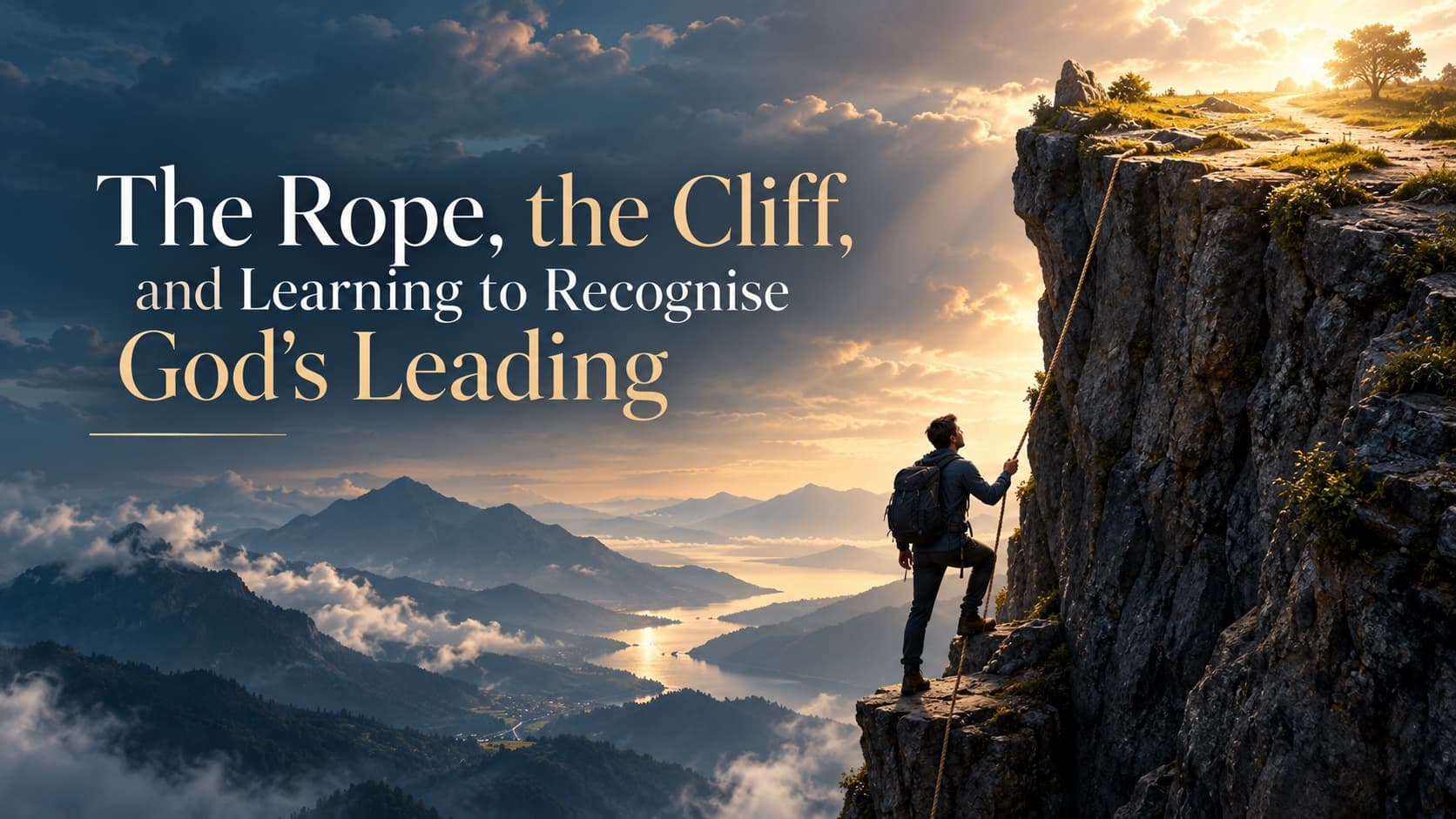
The Rope, the Cliff, and Learning to Recognise God's Leading
Sometimes the rope in your hand isn't an idol — it's God's provision. So how do you know when He is asking you to hold it, climb with it, or let it go?
I have been thinking about what it really means to trust God when the thing in your hand looks like the only reasonable thing keeping you alive.
Imagine a man at the edge of a cliff.
He is holding onto a rope.
Below him is a narrow pedestal—large enough to stand on, but not large enough to live comfortably. Above him is the top of the cliff: safety, freedom, perhaps even the fulfilment of everything he has been trying to reach.
He has several options.
He can stand on the pedestal while leaning on the rope. He is relatively safe, but restricted.
He can leave the pedestal and begin climbing. This means putting his full weight on the rope, enduring discomfort, uncertainty and the very real possibility of falling.
He can simply hang from the rope without progressing. Eventually, his strength will fail.
Or he can let go completely and trust that somehow, impossibly, he will not fall.
At first, the spiritual interpretation seems obvious.
The rope must represent some human substitute for God.
The pedestal must represent false security.
And letting go must represent faith.
But the more I have thought about it, the less comfortable I have become with that interpretation.
Because sometimes the rope is not an idol.
Sometimes the rope is simply the most reasonable means of survival available to you.
A job can be a rope.
Savings can be a rope.
A relationship can be a rope.
A business opportunity can be a rope.
Medicine can be a rope.
Planning can be a rope.
A professional adviser can be a rope.
None of these things are inherently opposed to faith.
In fact, any of them might be God's provision.
And that creates a much more difficult question:
How do I know when God is asking me to hold the rope, climb with it, or let it go?
The Problem With Calling Everything “Faith”
It is easy to romanticise letting go.
If I release the rope and somehow remain suspended in the air, everyone will recognise the miracle.
There is no ambiguity.
God did it.
But if I climb the cliff using the rope, the story becomes less dramatic.
Did God rescue me?
Did the rope rescue me?
Did my effort rescue me?
Was it all three?
And if I remain on the pedestal, perhaps I can convince myself that I am safe because God has provided something to stand on.
This is where discernment becomes more difficult than faith slogans.
Because sometimes the thing we call dependence on God is actually passivity.
Sometimes what we call wisdom is fear.
Sometimes what we call God's provision is something we have become incapable of imagining life without.
And sometimes what looks like radical faith is actually presumption.
The question therefore cannot simply be:
“Am I using the rope?”
The better question is:
“What is God asking of me here?”
David Asked Before He Pursued
This question became particularly important to me while reading the life of David.
In 1 Samuel 30, David returns to Ziklag to discover that the city has been burned and the families of his men taken captive.
His situation is catastrophic.
His own men are talking about stoning him.
Scripture says:
“But David strengthened himself in the LORD his God.”
Then David does something important.
He asks God:
“Shall I pursue this troop? Shall I overtake them?”
And God answers:
“Pursue.”
David then acts.
He doesn't sit down and say, “If God wants them rescued, He will bring them back.”
He pursues.
He fights.
He uses strength, strategy and human action.
Yet all of it follows God's direction.
That sounds very much like climbing the cliff with the rope.
But this raised another question for me.
Scripture says God answered David.
That language is quite direct.
David did not merely say:
“I have a strong feeling that I should pursue them.”
He received an answer.
And this exposed something in my own relationship with God.
I pray.
I trust God.
I sometimes have strong thoughts, impressions or perceptions about what I should do.
But I cannot always truthfully say:
“God told me to do this.”
And I don't want to build my relationship with God around treating every strong internal perception as His voice.
Not Every Thought Is “God Said”
I think Christians can sometimes place unnecessary pressure on themselves here.
We hear people say:
“God told me.”
“God said.”
“God showed me.”
And perhaps sometimes He truly has.
But I have become increasingly cautious about putting God's name behind something that may simply be my own judgment.
There is a meaningful difference between saying:
“God said this.”
and:
“I believe this may be where God is leading me.”
and:
“Having prayed and considered everything, I think this is the wisest thing to do.”
Those statements do not carry the same level of certainty.
And perhaps they shouldn't.
David lived in a period in which God provided recognised means of direct revelation. In some of these passages, David was enquiring through the priest and the ephod.
My everyday decisions do not usually work like that.
I cannot ask:
“Should I take this job?”
and expect an audible:
“Yes.”
So how does God expect me to live?
Perhaps Discernment Is Part of the Answer
Romans 12:2 says:
“Be transformed by the renewing of your mind, that you may prove what is that good and acceptable and perfect will of God.”
That verse has begun to mean something different to me.
Maybe spiritual maturity is not primarily becoming someone who receives constant supernatural instructions.
Perhaps it is becoming someone whose mind has been shaped by God deeply enough to increasingly recognise what is consistent with His character and His ways.
Philippians 1 speaks similarly about growing in knowledge and discernment so that we may “approve the things that are excellent.”
That sounds like formation.
God does not merely give instructions.
He forms people.
And perhaps part of His goal is not to make me permanently dependent on receiving a sentence from heaven before every decision.
Perhaps He wants to renew my mind.
To deepen my knowledge of His character.
To fill me with Scripture.
To correct my motives.
To surround me with wise counsel.
To teach me patience.
To expose my fear.
And through that process, teach me how to discern.
The Rope May Actually Be God's Provision
This also changes how I think about practical means.
In Acts 27, Paul receives a promise from God that everyone travelling with him will survive a violent storm.
That is supernatural assurance.
Yet their rescue still involves remarkably ordinary things.
There is a ship.
There are sailors.
There is swimming.
And when the ship eventually breaks apart, some people reach land by holding onto pieces of the wreckage.
God promised the rescue.
Pieces of wood participated in the rescue.
There is no contradiction.
God's sovereignty does not require the absence of means.
And perhaps that is one of the mistakes we sometimes make when thinking about faith.
We imagine that the more visible the means, the less God is involved.
But Scripture doesn't consistently work that way.
God can provide the rope.
God can strengthen your hands to climb the rope.
God can tell you to cut the rope.
And God can rescue you when there is no rope at all.
The spiritual question is not whether a rope exists.
It is whether my confidence has moved from the God who provides to the thing He has provided.
There is a subtle difference between saying:
“Thank God for this rope.”
and saying:
“Without this rope, there is no possible way I can survive.”
The first recognises provision.
The second may have quietly placed limits around God.
The Pedestal May Be More Dangerous Than It Looks
Then there is the pedestal.
The pedestal is interesting because it isn't disaster.
You can survive there.
You can even become comfortable enough to remain indefinitely.
But you cannot experience what lies above while refusing to leave it.
This may represent a particular kind of life:
not failure,
but not freedom either.
Not destruction,
but not peace.
A simulation of success.
Enough stability to make leaving frightening, but enough restriction to know that you were made for something more.
And here is the difficult part:
You cannot discover whether there is greater support beyond the pedestal while insisting on never leaving it.
Abraham cannot discover God as provider while Isaac remains untouched.
Israel cannot discover the God who parts seas while remaining in Egypt.
Peter cannot discover that Christ can sustain him on water while remaining in the boat.
But Peter's story contains an important safeguard.
He doesn't simply leap.
He says:
“Lord, if it is You, command me to come to You on the water.”
And Jesus says:
“Come.”
That may be the part of the story I am trying to understand most deeply.
The great act of faith was not merely leaving the boat.
It was responding to “Come.”
What I Am Actually Seeking
I don't simply want enough courage to let go of ropes.
That could be recklessness.
I don't simply want enough determination to climb every rope.
That could be self-reliance.
And I don't want to spend my entire life standing on safe pedestals because uncertainty terrifies me.
What I want is to know God well enough that my decisions increasingly flow from knowing His character and recognising His ways.
I want to know when the rope is His provision.
When it has become my idol.
When He is asking me to climb.
When He is asking me to wait.
And if the moment ever comes when He asks me to let go, I want my confidence to be in the One speaking rather than in my ability to understand what happens after I release my grip.
Maybe that is the deeper meaning of trust.
Not believing that God will always remove the cliff.
Not believing that He will always make us float.
Not believing that every rope must be abandoned.
But becoming convinced that whatever means God chooses, He remains the source of rescue.
Sometimes He says:
Stand still.
Sometimes:
Go forward.
Sometimes:
Pursue.
Sometimes:
Wait.
Sometimes He provides the rope.
Sometimes He asks us to release what we thought was keeping us alive.
The maturity I am seeking is not simply the courage to do something dramatic.
It is the discernment to know the difference.
And perhaps the deepest form of security is reaching a place where my confidence is no longer primarily in whether I have a rope, a pedestal, or a clear path to the top.
It is in knowing the One who is with me on the cliff.
When God Does Not Answer the Way We Expected
Faith is not proved by always receiving the outcome we asked for. Sometimes faith is continuing to trust God when His answer differs from our expectation.
October 7, 2026 · 3 min read
Ask, Seek, Knock
Persistence is not trying to exhaust a reluctant God. It is continuing to trust a willing Father.
October 7, 2026 · 3 min read
Pray and Watch
Faith does not force a choice between prayer and responsibility. Nehemiah prayed—and set a watch.
October 7, 2026 · 3 min read