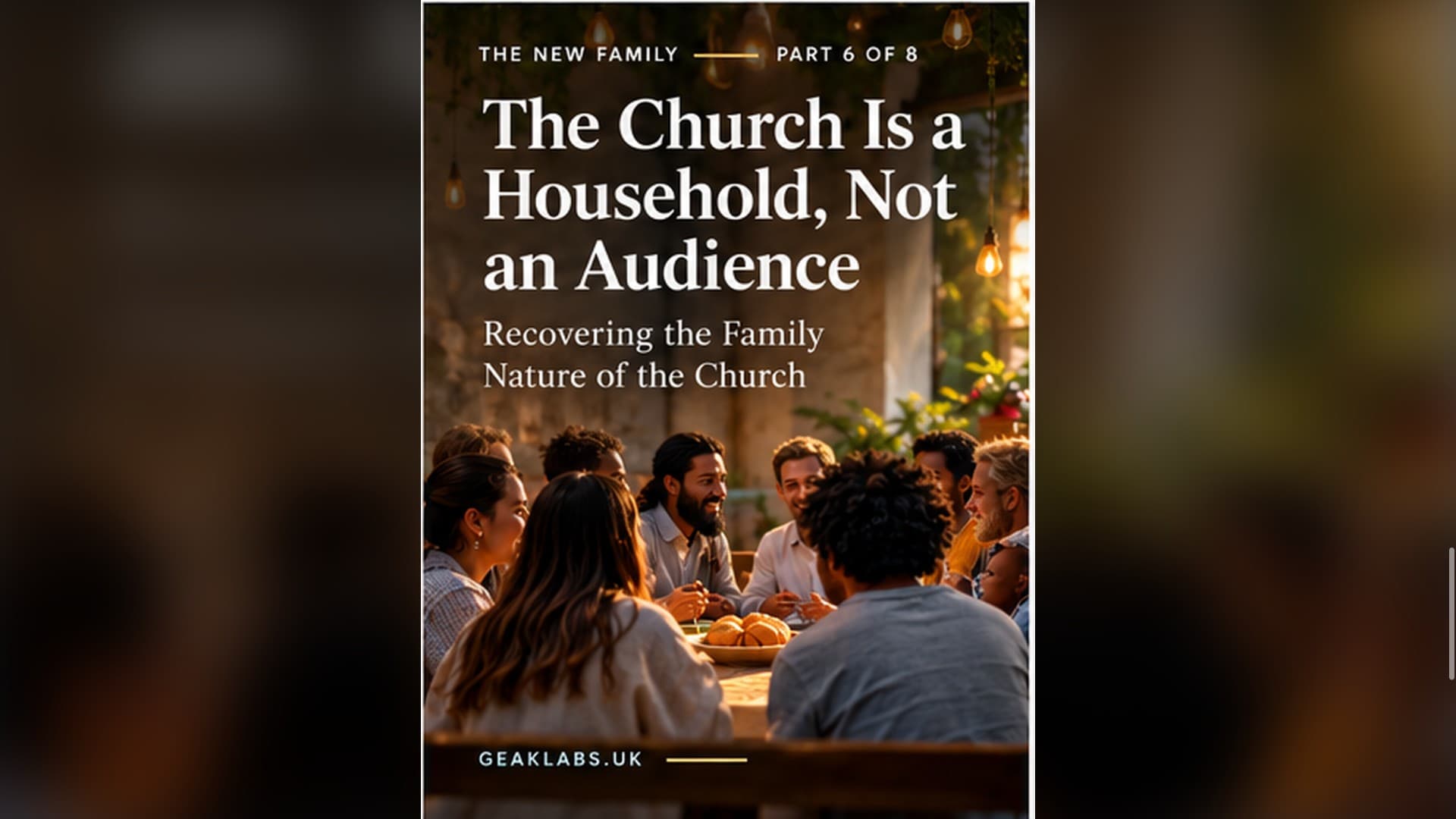
The Church Is a Household, Not an Audience
The New FamilyPart 6 of 8
Church was never intended to be a weekly audience gathered around a programme. In Christ, strangers become household.
Recovering the Family Nature of the Church
Modern life has trained us to think like consumers.
We attend.
Observe.
Evaluate.
Choose.
Leave.
And sometimes we bring that mindset into church.
Was the music good?
Was the sermon interesting?
Was the programme engaging?
Did the service meet my expectations?
Without realising it, church can become something we attend rather than a people to whom we belong.
But the New Testament uses much stronger language.
“The Household of God”
Ephesians says believers are:
“members of the household of God.”
That is family language.
The Church is not merely a weekly event.
It is a household created in Christ.
People who might never naturally belong together are reconciled and brought near.
Paul describes Christ as creating:
“one new man.”
The gospel does not merely reconcile individuals to God vertically.
It creates a new community horizontally.
The Church Is Also a Body
Paul gives another image.
A body.
Different members.
Different functions.
One life.
One Head.
The hand cannot say:
“I do not need the eye.”
The eye cannot say:
“I have no need of the hand.”
A body requires participation.
An audience does not.
That distinction matters.
Audiences Consume; Families Contribute
In an audience, a small number of people perform while everyone else watches.
In a healthy church, every member has something to supply.
Not everyone preaches.
Not everyone leads worship.
Not everyone has a public role.
But everyone can contribute.
Prayer.
Service.
Giving.
Encouragement.
Hospitality.
Mercy.
Wisdom.
Teaching.
Administration.
Care.
Presence.
The Body grows:
“according to the effective working by which every part does its share.”
Every part.
Family Means Being Known
Crowds allow anonymity.
Families make anonymity harder.
That can be uncomfortable.
To belong means people may eventually know where you are weak.
Where you need help.
Where you need correction.
Where you are hurting.
Where you are gifted.
Where you can serve.
Christian community is not always comfortable precisely because family is not always comfortable.
But growth often happens where we are known.
Family Also Means Responsibility
We often like the language of family when it means:
“People should care for me.”
But family also means:
“I have responsibility toward others.”
Who am I encouraging?
Who am I praying for?
Who am I helping?
Who am I discipling?
Whose burden am I carrying?
Who becomes stronger because I am part of this body?
Belonging creates obligation.
The Church Crosses Natural Boundaries
Natural families are organised around blood.
The new family is organised around Christ.
Ephesians brings Jew and Gentile into one household.
That means the Church should challenge the divisions of the old humanity.
Nationality.
Tribe.
Class.
Status.
Background.
Age.
Education.
Christ creates a deeper identity.
This does not erase culture.
But culture can no longer become the highest basis of belonging.
The Head Gives Life to the Body
The Church does not create its own life.
Christ is the Head.
Paul describes the Body as growing from Him.
That means Christian community fails when Christ becomes merely a brand name attached to an organisation whose actual life comes from something else.
Personality.
Money.
Celebrity.
Tradition.
Politics.
Social status.
The Body must remain connected to its Head.
A Household Raises People
Families are developmental.
Children are born.
Nurtured.
Corrected.
Fed.
Prepared.
A healthy church should function similarly.
The goal is not simply attendance.
Paul says ministry exists:
“till we all come… to the measure of the stature of the fullness of Christ.”
The household exists to help people grow up.
This Changes Leadership
Leadership in an audience tends toward performance.
Leadership in a family tends toward formation.
The question changes from:
“How do we keep people impressed?”
to:
“How do we help people mature?”
That may involve teaching.
Pastoral care.
Correction.
Opportunity.
Trust.
Accountability.
Discipleship.
And sometimes allowing people to fail safely while learning to serve.
This Changes Membership Too
If church is household, then asking:
“What am I getting?”
is incomplete.
We should also ask:
“What am I bringing?”
Not money alone.
My gift.
My attention.
My prayers.
My service.
My wisdom.
My presence.
My love.
Christ's New Family
The Church is not perfect.
Families rarely are.
But the Church is meant to be something more than strangers sharing a room once a week.
It is a Spirit-born household.
A Body joined to one Head.
A people learning the same family resemblance.
And perhaps recovering that vision would change the way we gather.
Less audience.
More participation.
Less consumption.
More service.
Less anonymity.
More belonging.
Because in Christ, strangers have become family.

When God Does Not Answer the Way We Expected
Faith is not proved by always receiving the outcome we asked for. Sometimes faith is continuing to trust God when His answer differs from our expectation.
October 7, 2026 · 3 min read
Ask, Seek, Knock
Persistence is not trying to exhaust a reluctant God. It is continuing to trust a willing Father.
October 7, 2026 · 3 min read
Pray and Watch
Faith does not force a choice between prayer and responsibility. Nehemiah prayed—and set a watch.
October 7, 2026 · 3 min read